The Euro 7 regulations will push road vehicle and internal combustion engine manufacturers to sacrifice engine efficiency in order to keep pollutant emissions below the prescribed limits under all engine operating conditions. This is a reality that will first impact light-duty vehicles and later heavy-duty ones as well
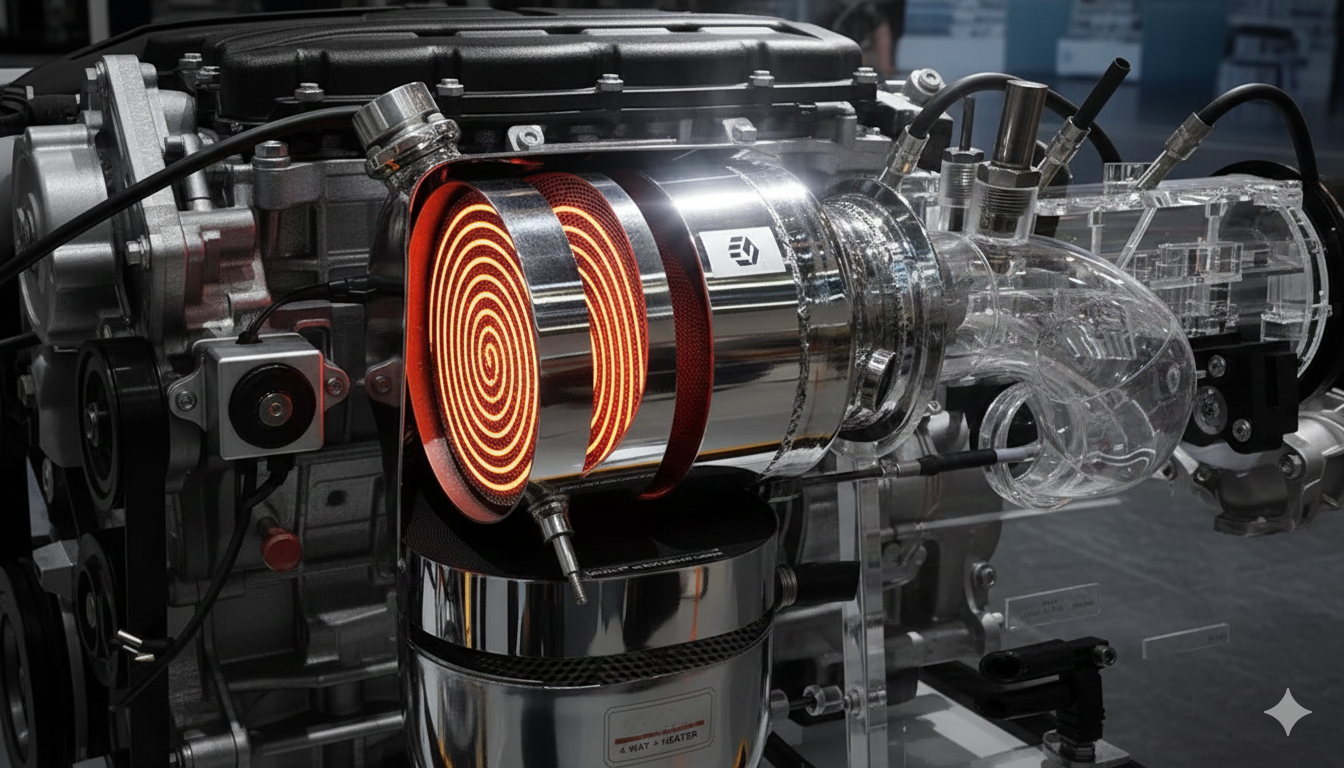
A specific research field currently being pursued by engineering departments involved in developing exhaust aftertreatment technologies concerns the possibility of using electrical components to optimize the thermal management of these systems. In recent years, several academic studies focused on the truck segment have shown that the use of “E-Hc” (Electric Heater Components) on heavy commercial vehicles—integrated into 48-volt mild-hybrid powertrains in a “P1” configuration—can significantly reduce nitrogen oxide emissions and overall pollutants by accelerating the warm-up phase of the aftertreatment chain.
This benefit is particularly relevant for diesel engines, as the effectiveness of SCR and DPF systems is highly dependent on their operating temperature. During transient cycles typical of congested urban areas—such as stop-and-go traffic—or when engines operate at low load in cold environments, SCR systems often fail to reach their optimal operating temperature (250–300°C) and consequently lose efficiency, just as particulate filters do if they do not reach approximately 70–90°C. The same occurs during cold starts. Under such conditions, particulate matter and NOx emissions may remain higher than current regulatory limits allow.
There are two main ways to prevent this: the use of the aforementioned E-Hc systems or the exploitation of part of the thermal energy generated during combustion. When positioned upstream of the SCR, E-Hc devices rapidly increase catalyst temperatures before the engine itself reaches a suitable thermal condition. For this reason, most automotive manufacturers are considering them as a solution for complying with upcoming Euro 7 standards, which do not necessarily tighten emission limits but require compliance “from the start,” meaning from the very first engine ignition.
However, integrating an E-Hc may shorten SCR warm-up times, but at the expense of slight increases in fuel consumption during the initial engine activation phase and whenever the vehicle operates under frequent transient conditions with low power demand. In practice, when installed in a P1 mild-hybrid powertrain, the E-Hc optimizes catalyst temperature quickly, enabling Euro 7 compliance from the earliest phases of vehicle use, but it penalizes engine efficiency during the aforementioned transient cycles typical of congested urban areas.
Under these conditions, achieving real emission benefits requires either more sophisticated hybrid configurations—such as P2 or P3 systems—or adjustments to injection timing and strategies to modify engine operation in order to heat exhaust gases. In other words, the E-Hc is used during start-up, followed by specific fuel mapping strategies to ensure “clean” exhaust gases almost as soon as the Start button is pressed.
Maintaining exhaust aftertreatment systems at the correct temperature is particularly critical for diesel engines, the most thermodynamically efficient internal combustion engines, with efficiencies exceeding 45%. These engines convert a large share of the fuel’s chemical energy into mechanical energy, minimizing consumption compared to spark-ignition engines of equivalent displacement and output. They also produce lower CO₂ emissions, making latest-generation diesels one of the most effective solutions for environmental sustainability challenges.
However, their higher efficiency means cooler exhaust gases compared to spark-ignition engines, which can make it difficult to meet the thermal requirements of aftertreatment systems, especially during short or low-load operation. This is even more pronounced in hybrid powertrains with significant electrification assisting the thermal engine.
As a result, light vehicle manufacturers find themselves forced to sacrifice engine efficiency in order to comply with regulations that, paradoxically, should encourage greater efficiency. In practical terms, E-Hc systems consist of very powerful electric resistors that contribute nothing to propulsion and serve only to align secondary emissions with regulatory requirements during cold or low-load transients.
Power absorption ranges from three to six kilowatts—up to twice the power typically available for domestic electrical systems. Assuming a 48-volt battery and an average absorption of 4.5 kW, this implies a continuous current exceeding 90 amperes delivered within seconds. Supplying such energy requires a dedicated battery capable of withstanding high stress and sized to handle strong, short discharge peaks.
The system must also integrate thermal management and battery state-of-charge monitoring. If the battery is depleted, the system should theoretically prevent engine start-up—though one hopes it will not. Beyond these technical and management challenges lies a fundamental principle: energy cannot be created from nothing, as stated by the French chemist Antoine-Laurent de Lavoisier in the late 18th century.
The energy supplied to the E-Hc must be generated by the internal combustion engine via the alternator, meaning additional fuel consumption and emissions will be incurred to meet this requirement. Consequently, to pollute less during the first few minutes after start-up, more fuel will be consumed and more emissions produced during regular operation.
This effect is amplified if exhaust gases are not sufficiently hot, forcing the engine control unit to modify injection parameters and timing to burn fuel during the expansion phase solely to generate heat for aftertreatment thermal management. This strategy is already used today for DPF regeneration but would become more frequent whenever low operating temperatures reduce system efficiency. In low-load, low-temperature conditions—such as winter urban driving—this operating mode could persist for extended periods.
Moreover, this solution introduces durability concerns. Injecting fuel during the expansion phase means spraying diesel when the piston has already exposed the cylinder walls, subjecting the protective oil film to fuel contact. This causes a washing effect (“wall wetting”) that removes lubrication from the cylinder walls, increasing wear on cylinder liners and piston rings and accelerating performance and efficiency degradation.
If even a small amount of diesel passes beyond the piston rings into the crankcase, it can deteriorate the lubricating properties of the oil. In current-generation engines, oil dilution occurs at roughly 2% every 20,000 kilometers. In future Euro 7 engines, oil degradation due to fuel dilution will depend on usage and environmental conditions, but tests indicate higher rates over time. In practical terms, Euro 7 engines will require more frequent oil changes.
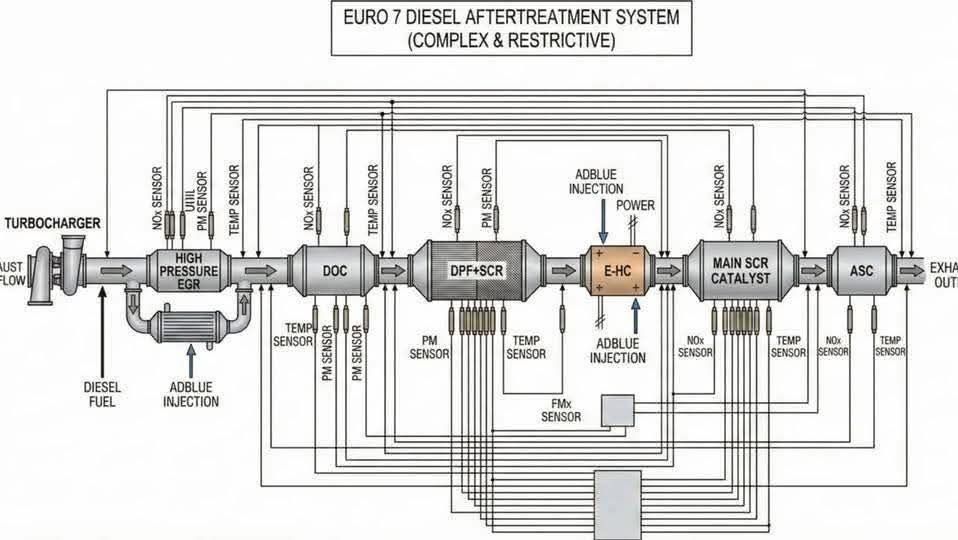
As if this were not enough, the aftertreatment system must also be complemented by a dual-stage EGR system to prevent NOx formation more effectively than in the past. The first stage operates at high pressure and is positioned near the exhaust manifold close to the cylinder, while the second stage operates at low pressure downstream of the particulate filter.
In addition to recirculating exhaust gases into the intake, the system causes condensation of the water contained in the exhaust gases and transfers it into the intake ducts, reintroducing it into the combustion chamber to reduce combustion temperatures. However, this is “acidic” water, which can attack the surfaces of components it contacts—from intake ducts and valves to turbocharger impellers and compressor housings.
Preventing such damage requires additional components, which further reduce overall engine efficiency and increase fuel consumption, emissions, and production costs. Higher urea consumption is also expected to catalyze a broader spectrum of nitrogen oxides, resulting in increased ammonia formation at the end of the process. This necessitates an additional filter, the “ASC” (Ammonia Slip Catalyst), to remove residual ammonia.
There is little doubt, therefore, that future Euro 7 engines will be more complex and less efficient than current ones—arguably the result of ideological positions lacking rational and logical grounding.
Title: What will change with the new Euro 7 regulations: news and limitations for engines
Translation with ChatGPT